
Why Your Face Changes With Age: Understanding Skin, Fat, and Bone
When we think about aging skin, we often think about wrinkles. But wrinkles are only one part of the story.
As we age, changes happen at several levels of the face. The dermis, the layer of skin that provides strength and support, becomes thinner and less elastic. The fat beneath the skin changes in both volume and position. Even the bones of the face slowly remodel over time.
Together, these changes help explain why the face may look different in your 30s, 40s, 50s, 60s, and beyond.
At Peak Skin Center in Fuquay-Varina, North Carolina, we believe understanding why your skin and face change is an important first step in deciding whether—and how—you want to treat those changes.
This article begins our Your Skin, Decade by Decade series by looking beneath the surface.
Layer 1: The Dermis
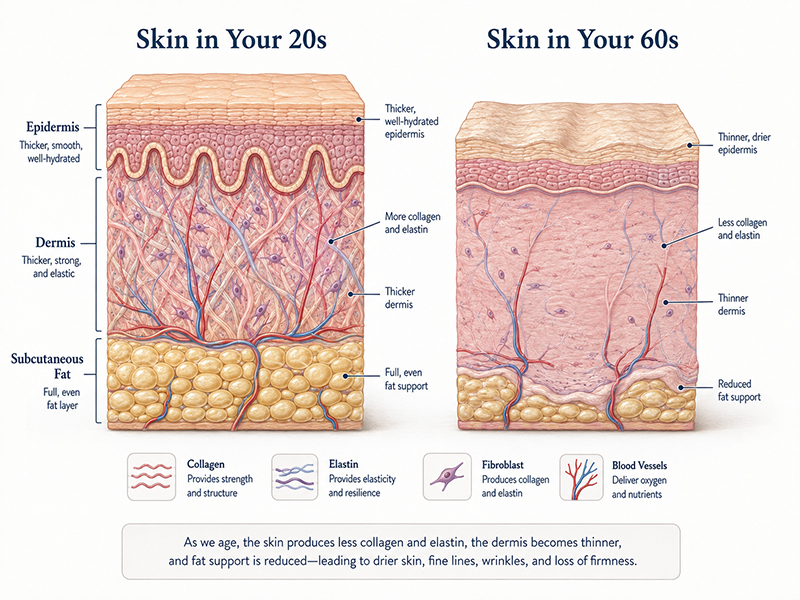
Your skin has several layers. One of the most important for aging is the dermis.
The dermis sits underneath the outer layer of skin and contains collagen, elastin, blood vessels, and other structures that give skin its strength, thickness, and flexibility.
Collagen decreases with age
Collagen acts like a support framework for your skin. When we are younger, our bodies continually make and remodel collagen.
As we age, collagen production slows. Existing collagen fibers also become more fragmented and less organized.
The result can be:
- Thinner skin
- Fine lines and wrinkles
- Less firmness
- Increased skin laxity
- Slower healing
Sun exposure can speed up this process. Ultraviolet radiation damages collagen and contributes to what dermatologists call photoaging.
This is one reason daily sunscreen is one of the most effective long-term skin-care habits at almost every age.
Elastin also changes
Elastin helps skin stretch and then return to its original position.
Over time—and particularly after years of sun exposure—elastic fibers can become damaged and disorganized. Skin may not “snap back” as easily as it once did.
This contributes to sagging, crepey texture, and deeper folds.
The skin holds less moisture
Aging skin also becomes less effective at holding onto water. Natural oils may decrease, and the skin barrier may become less efficient.
That can lead to dryness, flaking, irritation, and increased sensitivity.
This is why a skin-care routine that worked well at age 25 may no longer be ideal at age 45 or 65.
Layer 2: Facial Fat
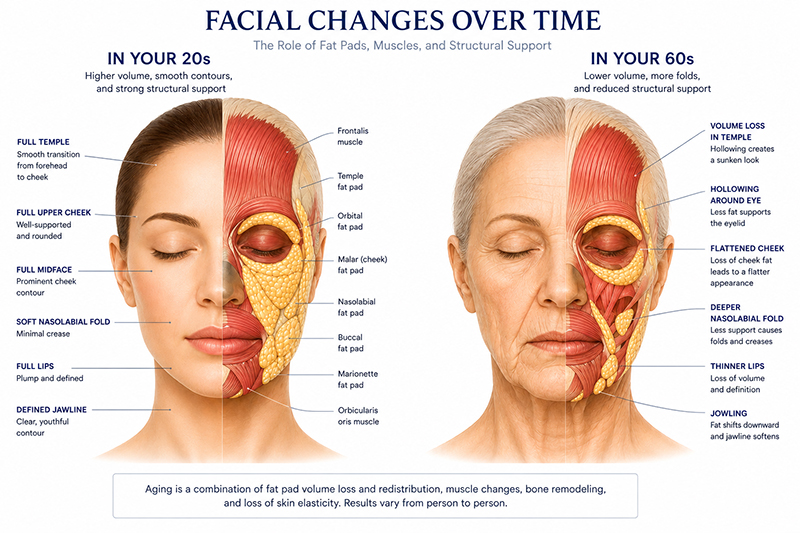
Underneath the skin are separate areas of fat called fat compartments.
One of the most important ideas in facial aging is that fat does not simply disappear evenly across the entire face.
Instead, some areas may lose volume while fat in other areas may remain, shift, or become more noticeable.
Where facial volume is often lost
Over time, we may lose some of the fullness that gives a younger face its shape.
Changes are commonly seen in areas such as the:
- Temples
- Cheeks
- Area beneath the eyes
- Midface
- Area around the mouth
Loss of support in these areas can make the face appear flatter or more tired.
The transition between the lower eyelid and cheek may become more noticeable. The cheeks may appear less full. Lines around the mouth may deepen.
Fat can also shift
Gravity, changes in connective tissue, and changes in the deeper structures of the face can alter where facial fat sits.
As support decreases, fullness that once sat higher in the cheek may appear lower.
This can contribute to:
- Deeper nasolabial folds
- Jowls along the jawline
- Changes around the mouth
- Less definition between the jaw and neck
This is one reason treating facial aging is more complicated than simply “filling a wrinkle.”
A wrinkle may actually be the visible result of changes occurring much deeper in the face.
Layer 3: Facial Bone
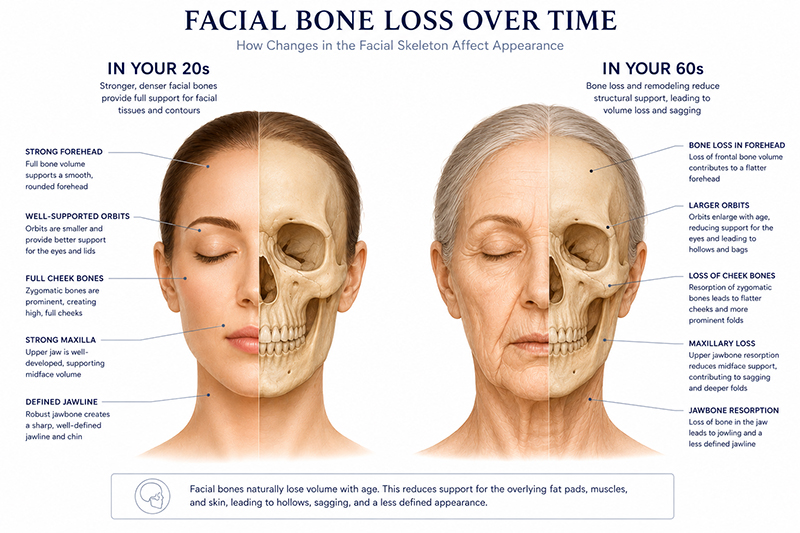
One of the least understood parts of facial aging happens even deeper.
The bones of the face change throughout adulthood.
Bone is living tissue. It is constantly being remodeled.
As we age, certain areas of the facial skeleton gradually lose volume or change shape.
These changes affect the support available to the skin, fat, and muscles above them.
Changes around the eyes
The bony opening surrounding the eye, called the orbit, tends to become larger with age.
As this underlying support changes, the tissues around the eyes can look different.
This may contribute to:
- Hollows beneath the eyes
- Changes in eyebrow position
- More noticeable lower eyelid bags
- A deeper transition between the lower eyelid and cheek
The problem is therefore not always simply “loose skin.”
The foundation underneath the skin is also changing.
Changes in the cheeks and midface
Bones of the midface also remodel over time.
As structural support decreases, the cheeks may appear flatter and the tissues above them may settle differently.
This can make folds and shadows more noticeable even when the skin itself has not dramatically changed.
Changes along the jaw
The jaw and lower face change with age as well.
Loss of bony support, dental changes, fat redistribution, muscle activity, and skin laxity can all contribute to a softer or less defined jawline.
Again, several layers are changing at the same time.
Aging Happens in Layers
This is perhaps the most important concept to understand:
Facial aging is not just a skin problem.
Imagine your face like a house.
- The bone is the foundation.
- The fat provides volume and shape.
- The dermis provides strength and support to the outer covering.
Over time, changes can occur at all three levels.
That is why there is rarely one treatment that addresses every sign of aging.
A skin treatment may improve texture and sun damage beautifully but will not replace lost facial volume. A treatment that restores volume will not necessarily correct discoloration or rough skin. And tightening loose skin cannot completely reverse changes in the underlying bone structure.
Why Treatment Should Be Individualized
Understanding these layers also explains why two people of the same age can look very different.
Genetics, sun exposure, smoking, weight changes, hormones, facial anatomy, skin type, medical conditions, and lifestyle all influence how the face ages.
One person in their 40s may primarily notice sun spots and fine lines.
Another may notice facial volume loss.
Someone else may be most bothered by jowling or skin laxity.
There is no single treatment that everyone “needs” at a certain age.
“The best approach to facial aging starts with identifying which layer is actually causing the change,” says Thomas Knackstedt, MD, board-certified dermatologist at Peak Skin Center. “Sometimes the concern is primarily in the skin. Other times it is related to volume, deeper structural support, or a combination of all three. Understanding the cause helps us choose treatments that make sense rather than simply treating every line the same way.”
Aging is normal. The goal of dermatology is not to make everyone look the same or to erase every sign of age. It is to help you understand your skin, keep it healthy, and choose treatments that fit your goals.
Dermatology and Cosmetic Skin Care in Fuquay-Varina, NC
Peak Skin Center provides medical, surgical, and cosmetic dermatology for patients in Fuquay-Varina, Holly Springs, Apex, Cary, and surrounding communities.
Thomas Knackstedt, MD, is a board-certified dermatologist and fellowship-trained Mohs surgeon with expertise in skin cancer, dermatologic surgery, and cosmetic dermatology.
If you have questions about changes in your skin or would like to discuss a personalized treatment plan, schedule an appointment with Peak Skin Center.
At a Glance
Dr. Thomas Knackstedt
- Double board certified in dermatology and Mohs Surgery
- Over ten years of experience providing evidence-based care
- Nationally renowned physician leader with numerous publications, lectures, and academic affiliations
- Learn more
